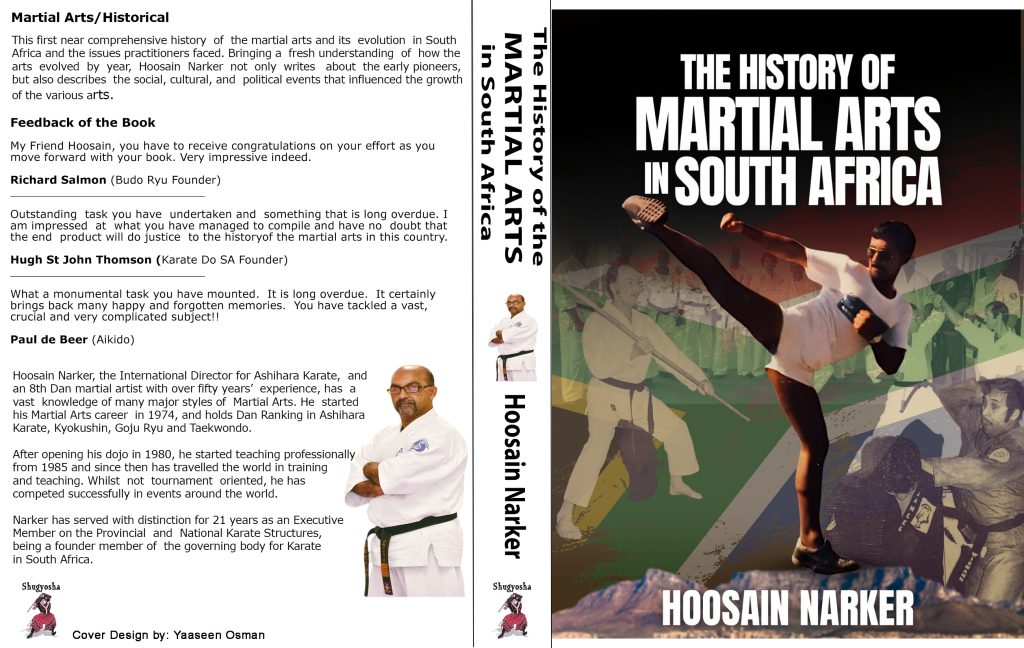
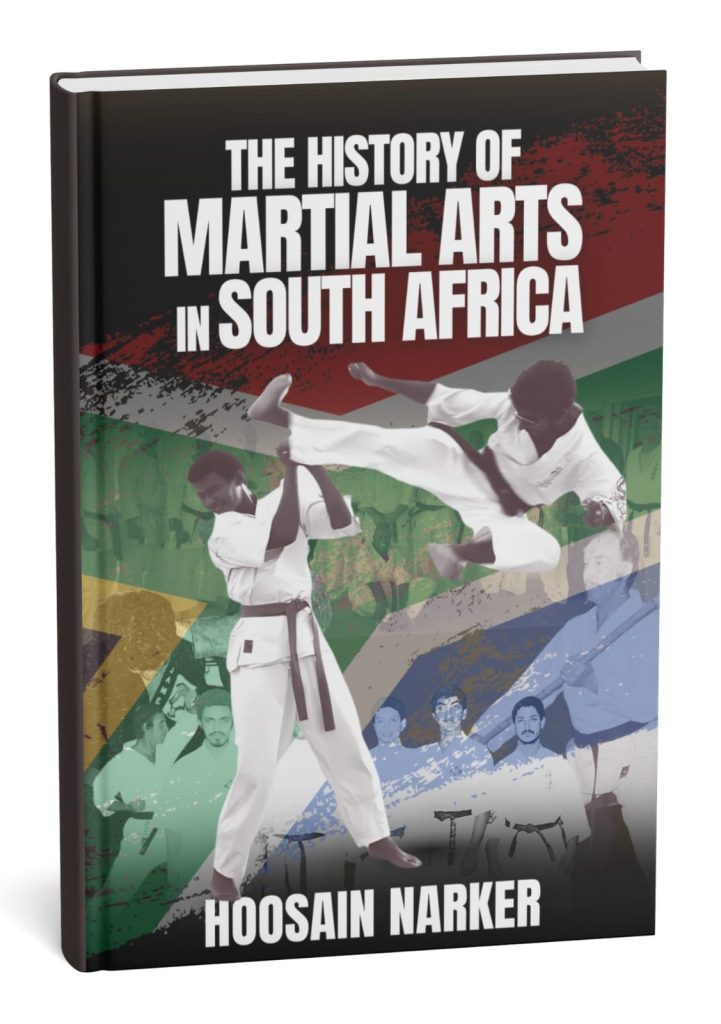
This is a new work on the History of the Martial Arts in South Africa. Currently at over 450 pages there is still lots to be done – research, chatting to of the old timer pioneers still with us and many others. Scheduled for release early in 2027.
What is the book about?
“The History of Martial Arts in South Africa” by Hoosain Narker is a comprehensive book that covers the topic from the introduction of fighting arts to 2026, spanning over 450 pages. The book highlights various martial arts disciplines, including traditional practices like Nguni stick-fighting and modern styles like Karate, Taekwondo, Judo, Brazilian Jiu-Jitsu, and Mixed Martial Arts.
Some of the key topics covered in the book include ¹ ²:
The book provides a detailed account of the history and evolution of martial arts in South Africa, highlighting its cultural significance and impact on communities. By including over 400 names of notable individuals mentioned in the book, it serves as a valuable resource for martial arts enthusiasts, historians, and researchers.
A Brief history of the Martial Arts in South Africa
Probably the first form of martial arts to arrive on South Africa’s shores came with the first arrival of Malay slaves in 1662. This was the Malay and Indonesian form of Silat. The Keris, the Malay dagger was often used on the streets of Cape Town against the Dutch oppressors.
As some of the Khoisan people were jealous about the Malay people’s culture and religion, there was a lot of hand to hand combat between the Malays “Pangs” – the Panglima Malay warriors and the Khoisan to the death.
Due to the clamping down by the Dutch authorities of the time, the fighting part of the art started winding down as later only of the “dancing” rituals ended up being practised in the “Khalifa” displays at religious gatherings.
Indian Kalaripayattu was brought to Cape Town in 1901 by Hazrath Soofie Saheb, as well as some of the South Indian indentured labourers and passenger Indians seeking new beginnings, but was never widely practised. So was the practise of the “Lahti” – the Indian forms of stick fighting. Eventually the practise would die out.
Boxing and wrestling were well known in South Africa before much was known about the Orient. Boxing was known as the manly art of self-defence and was practised bare fisted by a few hardy individuals who performed this bloody sport before groups of men betting on the outcome.
It is important to realise or to appreciate the fact that prior to dawn of democracy in 1993, karate, judo and most sports was controlled by a minority sympathetic to the Apartheid regime. South Africa’s sporting history, with its adherence to the abhorrent Apartheid was certainly not rosy and despite what many say today that they opposed Apartheid, or were supportive of Nelson Mandela or that they were card carrying members of the ANC, we must realise how that policy affected the many disadvantaged, causing many to quit or those that continued, simply could not reach their full potential due to the barriers imposed then. Some of these stories will appear in this work, stories which are not talked about much, but stories that must never be forgotten.
Here, in South Africa, racism has left its undeniable mark on our state, our DNA and our souls. Prejudice thrived in systems that were historically designed to keep non-white people in an inferior social standing. Keeping non- white institutions of learning, where sporting success can lead to lifetime success, in the similarly derelict state they were in during the segregation days, was a powerful way of killing the progress of non-white people. It was in this era that the martial arts had their roots.
While many martial arts have ancient origins, they have evolved to fit the demands of the modern world. Whilst karate was introduced well after jiu jitsu and judo, these martial arts and some others from Asia are not as popular as karate, but learning techniques used in them and other styles practiced by different cultures can help practitioners to evolve into well-rounded martial artists.
What is the book’s author’s background?
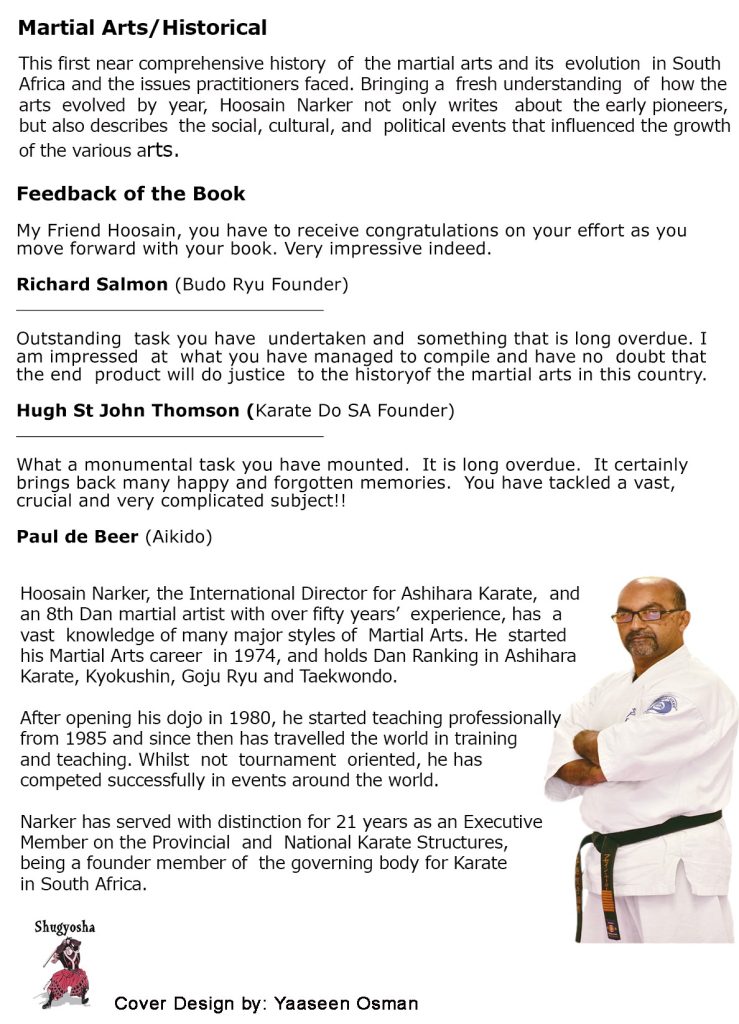
Hoosain Narker, the author of “The History of Martial Arts in South Africa,” has a rich background in martial arts. Born in Cape Town in 1963, he started training in Shotokan Karate at age 10 and the following year joined Shukokai Karate under Eric Smith and Jonathan Tommy. He later trained in Kyokushin Karate under Shihan Neville Paulsen and eventually joined the Japanese Ashihara Karate Organisation, becoming the International Director for a separate organisation – Ashihara Karate International.
Narker’s martial arts journey spans over five decades, with training stints in various styles, including:
He has also trained with renowned martial artists, such as Masutatsu Oyama, Teruo Hayashi, Hirokazu Kanazawa, and Joko Ninomiya and many top International teachers. Narker has competed in numerous tournaments, including the US Open Championships, and has been featured in various media outlets, including podcasts, radio shows, and interviews.
In addition to his martial arts career, Narker has written books, including “My Karate Odyssey,” which chronicles his six-month journey across North and Central America with his karate suit, backpack, and laptop. He continues to teach and promote Ashihara Karate globally.
Martial Arts History in S.A.
The following article was written in the early 80’s. Much has happened since then. The old Apartheid regime collapsed, a new Democracy took place and currently the country is undergoing a transformation. Karate has gone a total roundabout and today most of the sport codes have unified. Some of the sport codes have a shaky unity but in general more opportunities have arisen for those from previously disadvantaged backgrounds.
It is important to realise or to appreciate the fact that prior to the unification of karate in 1992, karate was only practised and controlled by a small minority sympathetic to the Apartheid regime. Universally it is now recognised that representative karate in South Africa only started at the Unification process.
A Brief history of the Martial Arts in South Africa
Boxing and wrestling were well known in South Africa before much was known about the Orient. Boxing was known as the manly art of self defence and was practised bare fisted by a few hardy individuals who performed this bloody sport before groups of men betting on the outcome.
The first Ju Jitsu club was started in Cape Town in 1928 by Dr. H. Johnson and Yusei Teppi. It was not, however, until 1931 that Ju Jitsu really began to establish itself. It was in that year the Prof. Jack Robinson, a Cumberland and Western Style Wrestling champion, came to South Africa, from England to wrestle. He had learnt Ju Jitsu in England from two Japanese experts, after having been persuaded during wrestling “challenge matches” that Ju Jitsu was a force to be reckoned with. In 1933 he started teaching Ju Jitsu and soon had schools operating is six major Cities in South Africa. His sons, having virtually grown up on the mat, worked as instructors and toured the country giving demonstrations thereby cultivating a great interest in Ju Jitsu and Judo.
Judo was further popularised in South Africa in 1945 by soldiers of the Second World War. Alec Butcher, a British Immigrant, was one of the earliest pioneers of the sport in the Cape and Mr Reay in Durban. Judo established itself as an organised sport on a national basis only in 1955 when the South African Amateur Judo Association (SAAJA) was formed.
Karate was formally introduced into South Africa in the early ’50’s by men such as Len Barnes, Richard Salmon, James Rousseau, Des Botes Stan Schmidt and Norman Robinson. These early pioneers of the art relied largely on text books for their knowledge and instruction. One of the first dojo was opened by Shihan Mohan Hira and a friend on a rooftop of a building called Commissioner House. By training on their own they progressed a great deal. Their exploring spirit in the quest for greater knowledge and new frontiers lead them to Japan in the early 1960’s where they received formal instruction in the art of karate. When James Rousseau got his black belt in Japan, the first South African to do so, Karate was firmly established. Judo man George Higginson brought top Shotokan Instructors Keinosuke Enoeda and Hiroshi Shirai to South Africa and “hired” them out to a few karate schools in existence then. This proved the basis for future visits by top Martial Art masters and from there South African martial artist also undertook regular visits to the far East. At that time other South Africans also began to dabble in karate, but it was not until 1964 that it became organised on a national basis.
“Shihon Dragon” and thereafter “First Dan S.A.” magazines began coverage of Martial Arts activities in the middle ’70’s. Although these magazines was read largely by those practising the martial arts, many other people outside the arts who was curiously interested in such activities read it. These two magazines gave needed publicity for some of the little known Martial Arts systems, styles and their teachers. The “Shihon Dragon” Magazine however concentrated mostly on one particular style of karate, nl. Kyokushinkai as the editor/publisher was a Kyokushin stylist. Numerous other publications were produced but none of them survived the long ordeal. It should also be mentioned that a lot of overseas martial arts publications were also sold in South Africa. An exchange of ideas and philosophies was thus promoted by these two magazines. Since that time there has been an exchange of karate techniques and ideas between various schools.
This exchange however did not result in the combining of the different styles and techniques as happened in the United States where today one cannot distinguish between competitors’ organisations without noting their different uniforms and insignia. One cannot even distinguish their style as everyone is borrowing techniques from other styles. In South Africa each style of karate kept its own National Tournament and only sometimes competitors from other organisations competed in it. This has slowly changed as the local karate scene compared itself with the international arena. In the USA and elsewhere they broke away from tradition as a survey shows. Some instructors here too have assumed high degrees of rank and are calling themselves Masters of the Art.
One of the major threats to the purity of the Martial Arts is commercialism. This threat is somewhat of a paradox in that when it was apparent that there was a profit to be made in the Martial Arts, more and more businessmen entered the scene. There were bona-fide Martial Artists amongst them wishing only to advance the arts and to earn a living at the same time, but others were only after a fast profit. Organisations was formed and chains of schools were created by the unscrupulous. Contracts were sold for high prices. Many students that had to drop the course for various reasons found that they were legally bound to pay full contract price even though they could not attend the classes.
Full Contact Knock-Down Karate entered the South African scene from the Japanese Kyokushinkai style which was introduced by transplanted Scotsman, Len Barnes, 8th Dan. Len, regarded as the father of karate in South Africa, tells how in the early 50’s karate was virtually unknown in this country. Because karate had its roots in the Far East, it was some time before English translations became freely available to spread the techniques. Len came up with the bright idea of waiting in Cape Town docks for ships from the Orient in the hope of bumping into a seagoing karate sensei from Japan or Korea. In 1958 his vigilance paid off when he was introduced to a first dan, a Mr. Nagatani. The honourable Mr. Nagatani had the golden egg in the form of an English translation of the Techniques of Kyokushinkai Karate (The book “What is Karate” by Mas Oyama).
From that fruitful meeting the movement evolved until it now has more than 100 000 adherents throughout the country. Len Barnes propagated KDK (Knockdown Karate) as a total karate self defence system, teaching falls and break falls to his eager pupils and in 1981 the S.A Kyokushinkai Association was honoured by a visit of the Supreme Master of Kyokushinkai, the legendary Masutatsu Oyama.
Public interest in the Martial Arts has been aided by Television and Movies. Although the Asian Countries have been making Martial Arts films for some time, the majority of the South African public had not been aware of it. One early display of an oriental fighting art was by Bruce Lee in the film “Big Boss”. Mr. Lee was shown using his art in combating crime with spectacular kicking and punching. This film and others thereafter brought many students into the martial arts all wishing to perform as they had seen Bruce Lee do so well.
His later movies filmed in Hong Kong and other locations were a boom to the popularity of the Martial Arts. After Mr. Lee died in 1973, many claimed to be as good or even better than he was. A flood of kung-fu and karate studio’s appeared all over the country. This also increased the enrolment in the karate studio’s throughout South Africa. Spectacular martial arts demonstrations further increased the enrolment in martial arts training halls around the country.
Full contact karate (KDK) is increasing in popularity with the general public due to the fast, hard, exciting karate that is displayed. As one bloodthirsty KDK explained. “KDK makes boxing look like slow motion fighting and other non-contact karate styles like shadow boxing. It’s the difference between “touch karate and the real thing.” Currently styles like Ashihara Karate which espouses Circular Methods and a “No-Tears – Punch without being Punched” approach is spreading like wildfire. Incorporating the rugged Knock Down system and a Semi Contact Continuous type of Sparring it has found a niche between the two extremes, i.e. Non-Contact and Knock Down.
Professional full contact karate as done in the USA, Europe and elsewhere, propagated by men such as Bill “Superfoot” Wallace, Benny “The Jet” Urquidez, Don Wilson, Jean-Yves Therialt and others has moved from an experimental stage to its infancy stage. Currently even with more competitors vying for rankings and with better exposure, kickboxing as it is also known has not overtaken other sports in popularity.
Other diverse martial arts systems also being practised here is Aikido, Kendo, and Kobudo (Kobu-Jutsu). South Africa also has a peculiar form of stick fighting with “knopkierries” practised by the native Zulu tribes. The Korean art of Tae Kwon Do is also practised, but due to infighting amongst the Korean Masters – have not really became a role-player. Kung-fu and other Chinese Arts like Tai-Chi are now deeply entrenched in martial arts circles throughout the country. Various people are also offering classes in Ninjutsu but it is not known whether they are really qualified to do so.
An art also being practised, but on a very small scale and mostly people with Malay origin is the art of Silat, also known as Pentjak Silat. Many Muslims partaking in “Khalifa” display’s are unaware that some of the rituals that they perform in their demonstrations, have in fact been taken from the various Silat systems. Filipino arts like Arnis/Escrima/Kali and knife fighting are also practised by some individuals around the country. Some of the Indians (those born in India) have some ability in Indian stick fighting known as “Lahti” but to my knowledge very few of them practise it.
In the last few years, Filipino Stick and knife fighting has really taken the fancy of a group of die-hard enthusiast. Many of these arts are practised at Gyms teaching a cross-section of arts which includes Brazilian Ju Jutsu, Savate, Muay Thai and Jeet Kune Do. What helps with the popularisation of these arts is the fact that a number of International instructors visit the country and the visit of local instructors abroad.
There are many positive developments that have taken place and although there is some difference in opinion as to what is and what is not good for the Martial Arts. South Africa was a difficult place to grow up in, during the sixties and seventies. The history of karate/budo was heavily influenced by the effects of the Apartheid System. Apartheid had brought about severe imbalances and disparities amongst the karate practitioners in South Africa. The dividing program of Apartheid was to categorise ethnic and racial divisions. It divided all of society, artificially segregating groups according to racial classification whilst referring to already existing ethnic and cultural differences. The specific hierarchy established by this ideology either created cultural entities or fostered those prevailing for the time-being and made them permanent. On top of the social pyramid were the Whites, followed by Indians/Asians and the Coloured population whose status was recognised to be superior to that of Blacks.
Thousands of people were reclassified by race and others could apply to have their racial status changed. Some Whites were reclassified “Coloured”, for example, if their hair was too curly or other features were thought to be too similar to Blacks. Apartheid (apartness) was conceptually introduced in 1948 with the victory of the National Party. Although these policies entrenched division in South Africa, they built upon the existing system of segregation that had pervaded society well before 1948. The White population (especially the Afrikaners) believed that their dominant position was scientifically, religiously and culturally justified. Martial arts were linked to politics because practically all existing organisations had to apply for a permit from the Minister of the Interior. This permit would allow people from all the race groups to join and practice the arts at so called “White” schools as they were then called. The American martial arts magazine, Black Belt, featured an article regarding this in one of their early issues (Vol. 4, No. 5, May 1966) entitled “Karate’s Introduction in South Africa Scares the Minister of The Interior.” Minister Jan de Klerk was petrified by the thought of karate as an offensive art falling into the hands of the disadvantaged who could use it to fight against the oppressors.
The Permit System was due to Apartheid and previously, several teams were picked for International matches, that is; a South African “White” team, a South African “Black” team and a South African “Indian” team. This led to South Africa’s expulsion from several International sporting organisations such as the International Olympic Committee, the International Amateur Athletics Federation as well as the World Union of Karate-Do Organisations (WUKO – now the WKF) – the official world governing body for karate. The last world tournament South Africa was allowed to participate in was the 3rd WUKO Championships in 1975 held in Long Beach, California, USA. * This made South African Karateka to train even harder and several of them has ventured overseas and fought or participated in International Meets under fictitious names and or countries. Many overseas experts has mentioned that they fear the day when South Africa will once again be allowed to participate in International Championships. Said one expert, “They will be like raging Bulls”. S.A Karate is currently ranked amongst the top 10 in the world.
White owned clubs considered themselves as multiracial and were proud when they had one or more members of other races training at their dojo. In 1971, the Multi National Policy had become official Government Policy whereby South African teams could only be mixed in competitions that included foreign athletes. Many of the non-racial instructors had their origins in the larger clubs which were associated with “Establishment Sport”. Dissatisfaction in the running of these organisations and the many blatant racist practices forced those “karate ka” to breakaway and operate in isolation without being affiliated to any national or international body. Only gratitude can be expressed for this type of dedication which kept the spirit of karate alive in the “townships”. This isolation resulted in a lack of external exposure causing a negative effect on development which influenced standards and deprived them of International recognition. Many of these instructors and organisations became dormant and were only able to develop internally at a rate which can only be measured by internal standards. A small number of instructors and organisations, despite being disadvantaged, managed to gain an acceptable degree of autonomy and standard of performance.
Popularity of the arts will bring more students to train and allow better public understanding but it also creates commercialism. New forms and changes can improve abilities but old forms and techniques may be neglected and lost. Full Contact practise with equipment might serve as realistic experience but sometimes causes sloppy and wild technique, injuries and a hostile attitude.
The best cause of action may be in educating the public and our students in the traditional philosophies of the martial arts in the hope that these goals will be more appealing than those selfish purpose appearing in today’s civilisation. As traditional discipline are diminished, so will civilisation and its progress.
* In 1992 South Africa was readmitted to the World Karate Federation and due to the progress made by the Karate Association of South Africa (KASA), it played host to the 13th World Karate Championships of the WKF in 1996 which reportedly was the biggest and best ever. Years of isolation has helped in creating a better relationship.
 D5 Creation | Powered by: WordPress